 Picture the daily operations in a large warehouse. Robotic systems work here in several different ways. When a truck backs up into a loading dock, an autonomous mobile robot (AMR) might unload packages onto a conveyor belt to route them to specific shelving locations. If the boxes have to be unpacked and sorted immediately, they might move to processing stations where people and robotic systems can cut them open, and pick, sort, and package products for delivery out of the warehouse.
A key technology underpinning all these mechanical helpers? Motion control.
“Motion control [in a warehouse] is important because it allows electrical and mechanical components to work together to solve complex problems in automation. It directly impacts efficiency, accuracy, safety, and scalability of operations,” says David Gelfuso, chief operating officer at Advanced Motion Controls (AMC), which designs, manufactures, and supplies servo drives and motor controllers
Mechanical Warehouse Helpers
Automation and motion control technologies make complex warehouse logistical operations easier. Automation addresses “the ultimate challenge,” for warehouse managers, which is rising operational costs, says Matt Charles, executive director of warehouse and logistics at FANUC, a global provider of automation solutions. FANUC focuses on robotic arms leveraging multi-access coordination to solve warehouse challenges. As a result, warehouse managers look to automation to move their products out faster, says Charles.
Automated guided vehicles (AGVs), AMRs, conveyor systems, palletizing robot arms, and collaborative robots are a few warehouse helpers that have gained traction in recent years, especially as the size of warehouses has increased. These mechanical helper systems in turn depend on motion control to facilitate precise interactions with their environment and move goods to where they need to go in the warehouse.
“Each automated application in warehouses, whether that’s conveyor systems or automated storage and retrieval systems, or robotic arms for palletization or AMRs, requires motion control,” Gelfuso says.
Why Precision Motion Control Matters in the Warehouse
When machines move packages from point A to point B in the warehouse, their motion has to be controlled. But when did precision become more important in motion control in the warehouse? And why do we need it in the first place? Recently, warehouses are seeing robotic equipment applied to new use cases, new levels of scale, and new kinds of flexibility, which often require precision motion control to reach their goals. Getting tasks done right the first time improves efficiency without injuries.
For example, shelving individual items and picking individual items from shelves requires robot arms or collaborative robots, equipped with more sensitive and precise end-of-arm grippers. These kinds of robots and their grippers require force and motion sensing, which requires precision motion control.
AMRs in warehouses run on software, which directs their navigation, planning, and motion. Precise motion control ensures that the software algorithms work accurately and that the AMR executes its actions without running into people or objects.
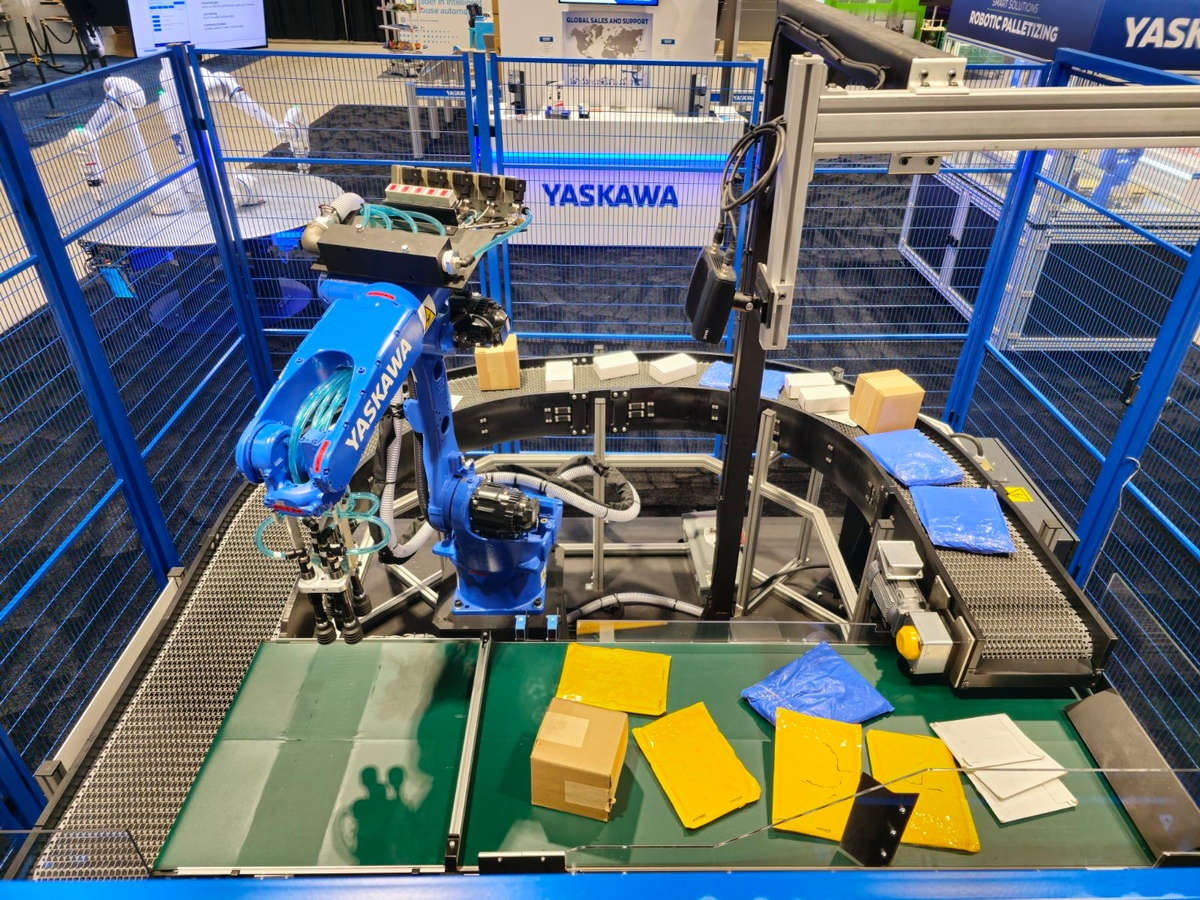
Vision-directed picking of objects from conveyors also runs on software that plans the motions of a robot arm. The robot arm requires more precise motion control because it needs to follow planned trajectories accurately, since they might pass close to obstacles.
Fortunately, advances in motion control have led to greater precision in warehouse operations. Whereas in the past, a warehouse might have had a basic AC induction motor driving a few belts, motion control today is a completely different entity controlling the velocity, position, and torque of machines, says Rene Yzmon, marketing manager at AMC. “Motion control is more precise because these warehouses need to have more efficient processes so they can know exactly when and how something will arrive,” he adds.
Under the Hood: How to Control Motion
A number of technologies and components have helped improve precision in motion control within the warehouse and beyond. They include:
Linear Motion Systems
A linear motion system is an automation system that controls a linear joint to achieve a goal. It can contain an assembly of several parts including a motor. For example, a conveyor is a linear motion system with motors whose rotational motion is converted to linear movement by an actuator.
Stepper Motors, Servo Drives, and Encoders
The simplest stepper motor systems have motors that can move to fixed positions. You only need to generate the correct number of electrical pulses to drive the motor through the desired number of steps.
For industrial-level precision when performing complex, coordinated motion tasks though, these simple systems do not deliver precise and reproducible actions. For higher-order reliability, more components come into play. A servo drive, for example, acts as a bridge between the motor that drives the motion and the robot or automation system that has the brains. The servo drive takes commands from the controller and converts them into usable power for the motor.
Once the robot has moved though, it needs feedback to ensure it has moved by the right amount. Feedback devices like encoders provide this function. The encoders along with the servo drives create a closed-loop system, allowing the controller to adjust torque, velocity, and position in real time for precise motion control.
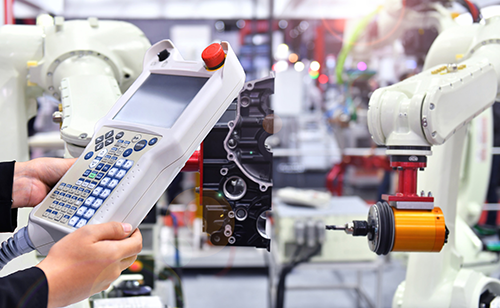
Typical industrial robot arms, like those from FANUC, are six-axis systems with six servo motors, one for each joint. Some of the bigger motors are at the base of the arm and the smaller ones are out toward the wrist or hand.
“Motion control is the next level up in automation and without a servo drive you drop back down to a lower level. You can still have a motor that helps move something, but you won’t be able to do it with the precision that you can with a closed-loop servo system,” Gelfuso says.
Collision Avoidance Technology
Whereas position-controlled robots move quickly and require cages or fences, advances in motion control, and the ability to monitor force and torque, have helped reduce the need for cages, Charles says. Improvements in motion control algorithms, especially reliable torque and force control, has led to collision avoidance, a technology that has been key in the development of collaborative robots that can work alongside humans in warehouses.
To have a robot arm move from point A to B, the path plan between the points must be charted to coordinate motion between each of the axes. Collision avoidance technology is instrumental in executing these actions. “Instead of swinging around and hitting an object and just powering on through, we can now sense that there has been contact and withdraw,” Charles says.
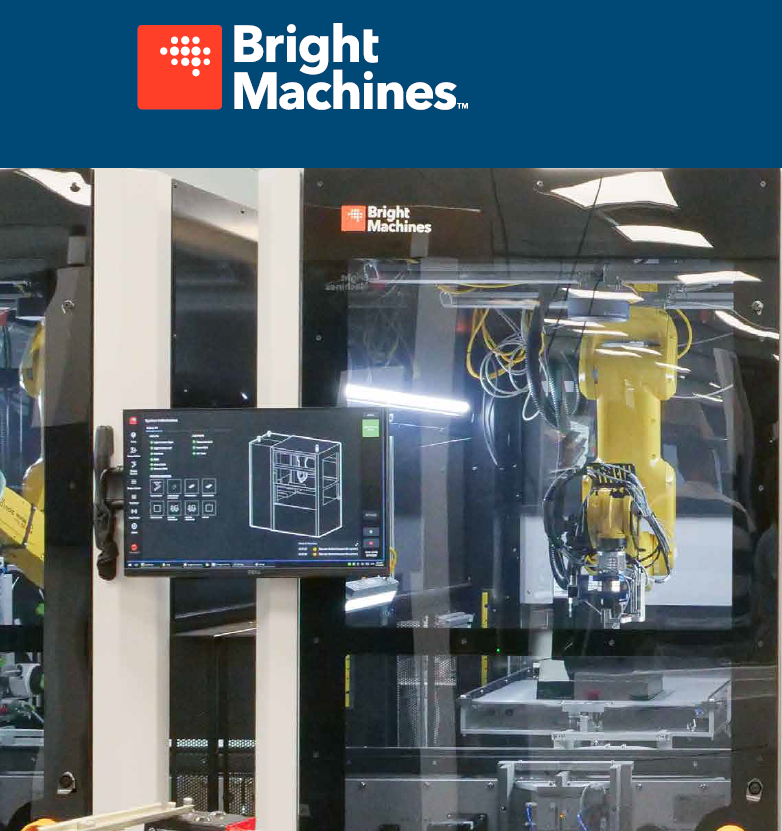
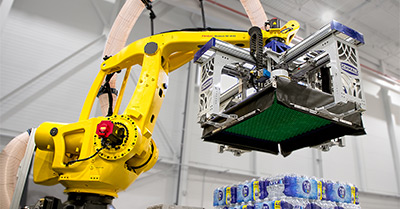
Having collaborative robots is a game-changer because it reduces the overall footprint of the automation solutions and they can be more easily integrated into warehouses. “You simply have the arm and some vision systems and grippers and that’s a good entry point,” Charles says. Palletization solutions start with these basics.
Software and AI in Motion Control Technology
Workflow automation and AI are also reshaping the warehouse and motion control processes. Modern computer software takes automation workflows and makes them more flexible and easier to use by eliminating manual steps during installation, configuration, and deployment.
AI is also improving package handling processes. Traditional vision systems have struggled to differentiate between small packages in postal facilities for example. But with advances in machine learning algorithms for image classification, a more robust version of computer vision can now automatically identify and sort packages in impressively granular detail. Installing a new package sorting system and scaling the deployment of new workflows becomes easier and quicker, requiring less engineering time.
Improved vision systems controlling motion are now capable of more precise and reliable detection of work pieces and their poses. A robotic pick-and-place operation, for example, does not need to be programmed carefully for particular workpiece poses, and the workpieces do not need to be presented to the robot in a particular pose. Such dexterity eliminates a lot of manual work in deploying an automated cell.
AI-driven controls can auto-tune PID (proportional, integral, derivative) loops and adapt to changing loads or friction in real time. Predictive motion optimization involves learning and refining motion behavior by studying historical patterns and optimizing real-time behavior.
Such complex machine learning algorithms leverage a hybrid cloud-edge AI model where the algorithms are frequently updated by new edge use cases and the decisions themselves happen in real-time at the edge.
The Future of Motion Control in Warehouse Operations
The future of warehouse automation and motion control emphasizes leaner and cleaner motors and drivers, which consume less energy and weigh less to optimize power spend when used in robotic systems. Regenerative drives will recover and reuse braking energy just as in on-road vehicles.
Gelfuso sees motion control evolving with the evolution of robots. “There’s more autonomy in the next generation of robots with a lot more dexterity. They will have more degrees of freedom,” he says. “What I see today is you have a robot or an automation system designed to solve a problem, but going forward, I see the opportunity to provide solutions that solve multiple problems, which will mean more complex robotics,” he adds.
And more complex robotics equals more precise motion control — in the warehouse and beyond.