Artificial intelligence (AI) is no longer just a futuristic concept — it’s already making a real impact on the factory floor. In fact, over 75% of U.S. manufacturing executives are actively exploring or using AI in their operations, according to the Manufacturing Leadership Council.
It’s paying off: Among those who have already deployed AI technology, 72% say that it reduced their costs and increased operational efficiency, according to the National Association of Manufacturers. These results suggest that AI isn’t just helpful — it can be a game-changer in highly competitive industries. McKinsey & Company even calls AI the driving force behind the fourth industrial revolution, where smart machines help businesses make better, faster decisions.
What is AI in manufacturing?
AI software transforms manufacturing tasks previously performed manually or with machinery, says Dr. Nitin Gupta, vice president of Dori AI, which produces an AI video intelligence platform that delivers real-time visibility into production lines as well as operational insights. Advances in AI vision and data analytics that use a type of machine learning called deep learning have made the AI revolution in manufacturing possible.
“With AI, software has the ability to recognize a part, a process, and people’s actions in a manufacturing environment. That enables the automation of processes that previously required manual intervention or interpretation by a human,” he says.
Dr. Gupta explains that AI solutions identify deviations from the norm in real time and act automatically or alert a human right away. By avoiding problems entirely or finding them more quickly, AI solutions improve product quality, lower waste, and keep production lines running.
In practical ways, AI brings complex computing to the factory floor. The top use cases for AI in manufacturing are quality inspection, equipment monitoring, standard operating procedure (SOP) monitoring, and worker training. Many of the tasks involved in these use cases depend on recent advances in AI vision and deep learning. Other use cases for AI, such as predictive maintenance and demand forecasting, rely on advanced data analytics.
AI in manufacturing is easier to deploy, lower cost, and more beneficial than you may think
“Many manufacturers expect AI to be too complex or costly to get started. In fact, AI is easily accessible and scalable,” Gupta says. “By abstracting away the complexity, AI solution providers and system integrators can offer full-stack turnkey and no-code products, so in-house AI expertise is no longer needed.”
The best way to get started, he says, is to choose an application and implement the project in stages – making sure you have the service and support you need to ensure success.
Davide Pascucci, CEO of Bright IA, a system integrator of intelligent automation systems, adds that recent advances in AI vision systems have created use cases for factory automation that deliver an excellent return on investment.
“We’re seeing some of the best ROI from AI solutions for inspection, defect detection, and parts identification — at least partly because AI systems deal with variances and surfaces that traditional vision systems cannot. In a month of AI model training, we saw a manufacturer detect defects earlier on the line, fix the problems, and save money,” he says.
Pascucci goes on to say, “Manufacturers learn about AI through pilot projects. If a manufacturer identifies production problems they’d like solved, we can look at the list and educate them on whether AI can solve those problems and where AI delivers the best ROI. A hardware vendor and system integrator will work in tandem to deliver a complete solution.”
How manufacturers use AI
Our team of experts shared several real-world examples of AI in action.
AI defect detection saves appliance manufacturer $500K in rework and scrap
Gupta of Dori AI shares results achieved by a large manufacturer of home appliances. The company implemented an AI vision solution on an assembly line that exhibited high defect rates. The AI solution inspected units in real time and found problems the operators who performed manual inspections missed. The solution enabled the manufacturer to quickly find the root causes of the defects and reduce those defects by 30% in the first six months. Inspection time went down, more units were produced, and revenue on the line went up. The appliance manufacturer saved $500K through less rework and scrap. After starting with a single production line as a test case, the manufacturer is replicating the use case to other production lines using the same AI solution, he says.
AI process monitoring reduces warranty claims by 60%
In another example, an automotive manufacturer faced high warranty claims due to manufacturing defects and also saw strong results. As Gupta explains, items arrived at the end-of-the-line inspection station with assembly errors, such as missing parts and bolts inserted in the wrong order. These errors resulted in large numbers of unhappy customers who experienced fluid leaks and, accordingly, made warranty claims. To address these issues, the manufacturer began monitoring the assembly process with an AI vision solution. As a result, they were able to catch errors at each station, improve worker training, and produce higher-quality automotive parts.
AI sorting system accurately inspects plastic flakes for safe reuse
For the food and beverage industry, a company that recycles food-grade plastics, such as water bottles, needed to inspect plastic flakes from shredded bottles to ensure purity for reuse. An AI vision system trained with thousands of images performed the repetitive task of checking for foreign particles much better than a human worker, says Bruno Ménard, software director for the DALSA division of Teledyne Vision Solutions, a provider of high-performance imaging technology. The creator of the flake analyzer used a code-free AI training tool to quickly deploy AI models for the solution.
“AI solves problems impossible to solve with traditional image processing, like the sorting of irregular materials,” Ménard explains. “In this case, each flake needed to be located, classified by composition and sorted correctly. Object detection is a well-studied deep-learning technology, and sorting objects and particles of any size is an excellent task for AI vision solutions,” he says.
AI welding inspection system on a cobot arm aims for 95% detection rate
AI vision systems give cobots new capabilities that boost visual inspection skills. Pascucci of Bright IA describes a system with a cobot that inspected welded parts on a production line. When a part reached the end of the conveyor, a camera-wielding cobot inspected four tap welds. A server ran deep-learning image analysis software designed specifically for factory automation, trained with pictures of good and bad tap welds. The server returned a result that allowed the accepted part to proceed or alerted an operator to an issue.
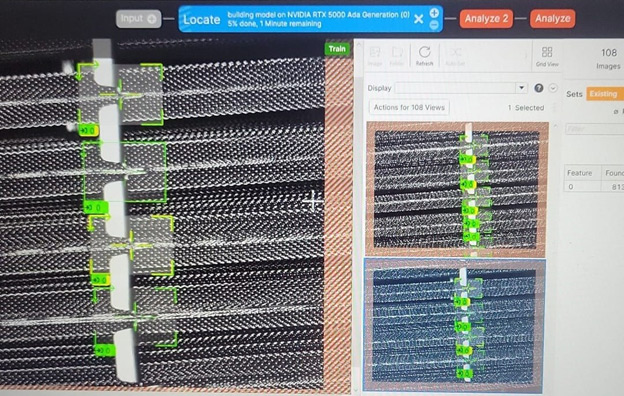
AI vision as an ideal task for welding inspection that involve variances, Pascucci says. After a few months of training, the system can deliver good results. Reading QR codes in variable lighting conditions is another use case for AI vision. “A system read QR codes at speed with 99.9% accuracy,” adds Pascucci.
How manufacturers get started with AI
To get started with AI, here are a few recommendations from our experts.
Start small, measure results, and then scale
Gupta recommends starting with a specific problem in one or two areas where AI can have the most impact, such as defects, assembly accuracy, or process automation. “Find a pilot project to gain experience on one production line or product. Start small. It takes time to absorb — so it’s fine to start with one camera on one line,” he says. “Then validate the project and assess the ROI. Scale based on the ROI and utility you experience in your manufacturing facility.”
Pascucci agrees, “Look around your plant to see in what areas you struggle, then aim to fix something simple. As you experience the value of AI, expand the solution to other production lines or take on another use case based on what you learned.”
Invest in data collection now
Start collecting data today for a future AI system, recommends Ménard. “AI development starts with a data gathering phase where sample images are collected and categorized. You need tens to hundreds of samples with which to train the AI model to achieve a system that works well, depending on the application. You won’t regret having more data,” he says.
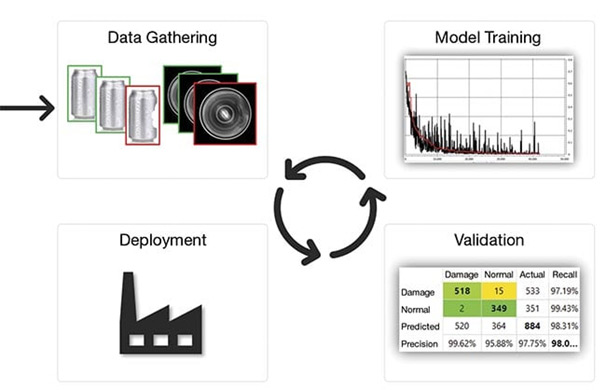
But what if you want to start using AI, but validation reveals that you don’t yet have all the data samples needed for high accuracy? “You can deploy an AI system as a helper to guide a human being,” Ménard says. “We’ve done this at Teledyne. We saw an opportunity to use AI to inspect dust on sensors but achieved only 93% accuracy with the data we had — not enough to fully automate the process. Still, we deployed the system as is to reduce the time spent by a human operator, and it lowered production costs.” The dust detection solution may be fully automated in the future as the company trains it with more data.
Train your workforce alongside the AI system
Don’t just deploy an AI system and walk away from it, advises Dr. Gupta. Instead, keep a human in the loop, someone whose job it is to ensure the AI system runs correctly. Train operators to understand what AI can do and how AI improves their ability to execute their job. In the most successful innovative manufacturers, everyone in the chain has a stake in the AI solution and needs to understand its benefits and value, he says.
Identify the areas in which your plant struggles
Take some time to look around your plant and make a list of areas in need of improvement. AI helps manufacturers solve many different production issues. Keep in mind that in some applications an AI solution helps a human operator achieve better and faster output, while in other cases, AI fully automates a task with operator oversight.